
ALIGN Case Studies – Full Series

ALIGN Case Studies – Full Series

Blog, Case Studies, News
The series is produced by the ALIGN Consortium as part of our shared learning agenda. Each case study—featuring Thailand, the Netherlands, and Ghana—examines how a particular country has navigated the persistent challenge of introducing new health innovations—how it evaluates, prioritizes, finances, and sustains them within real fiscal and political constraints. Our aim is not to rank systems or prescribe a single model, but to understand how reform actually unfolds: what enables it, what constrains it, and what does and does not transfer across contexts. These cases inform ALIGN’s work alongside national partners and are offered in the spirit of mutual learning. We welcome reactions, corrections, and counter-examples from colleagues who know these systems first-hand.
Read More
Case Study Series – the Netherlands

Case Study Series – the Netherlands

Blog, Case Studies, News
📄 Download the full Netherlands case study. (Also in this series: Ghana and Thailand.) Health leaders in all health systems must make critical decisions about which products―including diagnostics, medical devices, medicines, and vaccines―and services to provide within the constraints of their health budget. Between the global pipeline that brings technologies to market and the national systems that must deliver them at scale lies a critical inflection point: health innovation introduction. Prioritization―which often includes health technology assessment (HTA) processes―is an essential function of innovation introduction, as are the coordinated set of national and subnational processes through which innovations are prepared for sustained, scaled access (e.g., regulatory review, procurement, supply chain planning, etc). The Netherlands offers a case of disciplined innovation introduction in a high-income system, where insurance coverage is never automatic on…
Read More
Case Study Series – Ghana

Case Study Series – Ghana

Blog, Case Studies, News
📄 Download the full Ghana case study. (Also in this series: Thailand and the Netherlands.) Health leaders in all health systems must make critical decisions about which products―including diagnostics, medical devices, medicines, and vaccines―and services to provide within the constraints of their health budget. Between the global pipeline that brings technologies to market and the national systems that must deliver them at scale lies a critical inflection point: health innovation introduction. Prioritization―which often includes health technology assessment (HTA) processes―is an essential function of innovation introduction, as are the coordinated set of national and subnational processes through which innovations are prepared for sustained, scaled access (e.g., regulatory review, procurement, supply chain planning, etc). Every health system faces difficult choices about which innovations to fund and how to make the best use…
Read More
Case Study Series – Thailand

Case Study Series – Thailand

Blog, Case Studies, News
📄 Download the full Thailand case study.  (Also in this series: Ghana and the Netherlands.) Health leaders in all health systems must make critical decisions about which products―including diagnostics, medical devices, medicines, and vaccines―and services to provide within the constraints of their health budget. Between the global pipeline that brings technologies to market and the national systems that must deliver them at scale lies a critical inflection point: health innovation introduction. Prioritization―which often includes health technology assessment (HTA) processes―is an essential function of innovation introduction, as are the coordinated set of national and subnational processes through which innovations are prepared for sustained, scaled access (e.g., regulatory review, procurement, supply chain planning, etc). Thailand’s approach to health product prioritization―among the most fully institutionalized in middle-income countries―is anchored in the Health Intervention and…
Read More
Implementing AMR Surveillance Sustainably in Africa: Insights and Lessons from Ghana, Kenya, and Uganda

Implementing AMR Surveillance Sustainably in Africa: Insights and Lessons from Ghana, Kenya, and Uganda

Blog, Case Studies
Antimicrobial resistance (AMR) is a significant global public health menace. When antimicrobials are ineffective against previously treatable infections, it undermines the ability of health systems around the world to treat even minor infections, resulting in more expensive treatments, and excess mortality and morbidity when infections become untreatable. A recent study on the burden of AMR estimates nearly 5 million deaths associated with bacterial AMR in 2019, with 1.3 million deaths attributable to bacterial AMR 1, suggesting that AMR is at least as large as HIV and malaria. Of all the regions, Sub-Saharan Africa has the highest mortality rate from bacterial AMR at 27.3 deaths per 100,000.1 This high burden is exacerbated by a shortage of trained professionals and limited microbiology laboratory capabilities. In fact, only 1.3% of the 50,000 medical laboratories in…
Read More
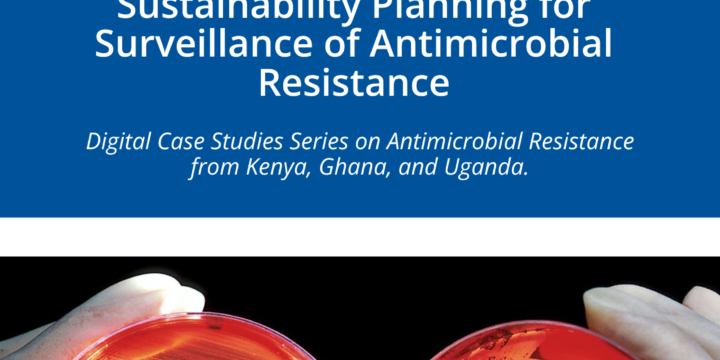
Sustainability Planning for Surveillance of Antimicrobial Resistance: Digital Case Studies Series on Antimicrobial Resistance from Kenya, Ghana, and Uganda.

Sustainability Planning for Surveillance of Antimicrobial Resistance: Digital Case Studies Series on Antimicrobial Resistance from Kenya, Ghana, and Uganda.

Case Studies
via Innovations in Healthcare. Antimicrobial resistance (AMR) is a significant global public health menace. The highest mortality rates are seen in Sub-Saharan Africa, where there is a significant shortage of trained professionals and microbiology laboratories for antimicrobial susceptibility testing. To address this, Pfizer Inc., Wellcome Trust, and the Ministries of Health in Ghana, Kenya, Malawi, and Uganda initiated the Surveillance Partnership to Improve Data for Action on AMR (SPIDAAR), a pilot public-private partnership. SPIDAAR aimed to enhance AMR surveillance by training staff in eight hospitals across four countries to conduct diagnostics on 100 isolates per site for five leading pathogens. The isolates were sent to the National Institute for Communicable Diseases (NICD) in South Africa for confirmation, facilitating trend analysis and feedback on culture accuracy. In May 2021, Pfizer engaged Innovations…
Read More