
📄 Download the full Netherlands case study. (FR | Pays-Bas)
Also in this series: Ghana (FR | Ghana) and Thailand (FR | Thaïlande).
Health leaders in all health systems must make critical decisions about which products―including diagnostics, medical devices, medicines, and vaccines―and services to provide within the constraints of their health budget. Between the global pipeline that brings technologies to market and the national systems that must deliver them at scale lies a critical inflection point: health innovation introduction. Prioritization―which often includes health technology assessment (HTA) processes―is an essential function of innovation introduction, as are the coordinated set of national and subnational processes through which innovations are prepared for sustained, scaled access (e.g., regulatory review, procurement, supply chain planning, etc).
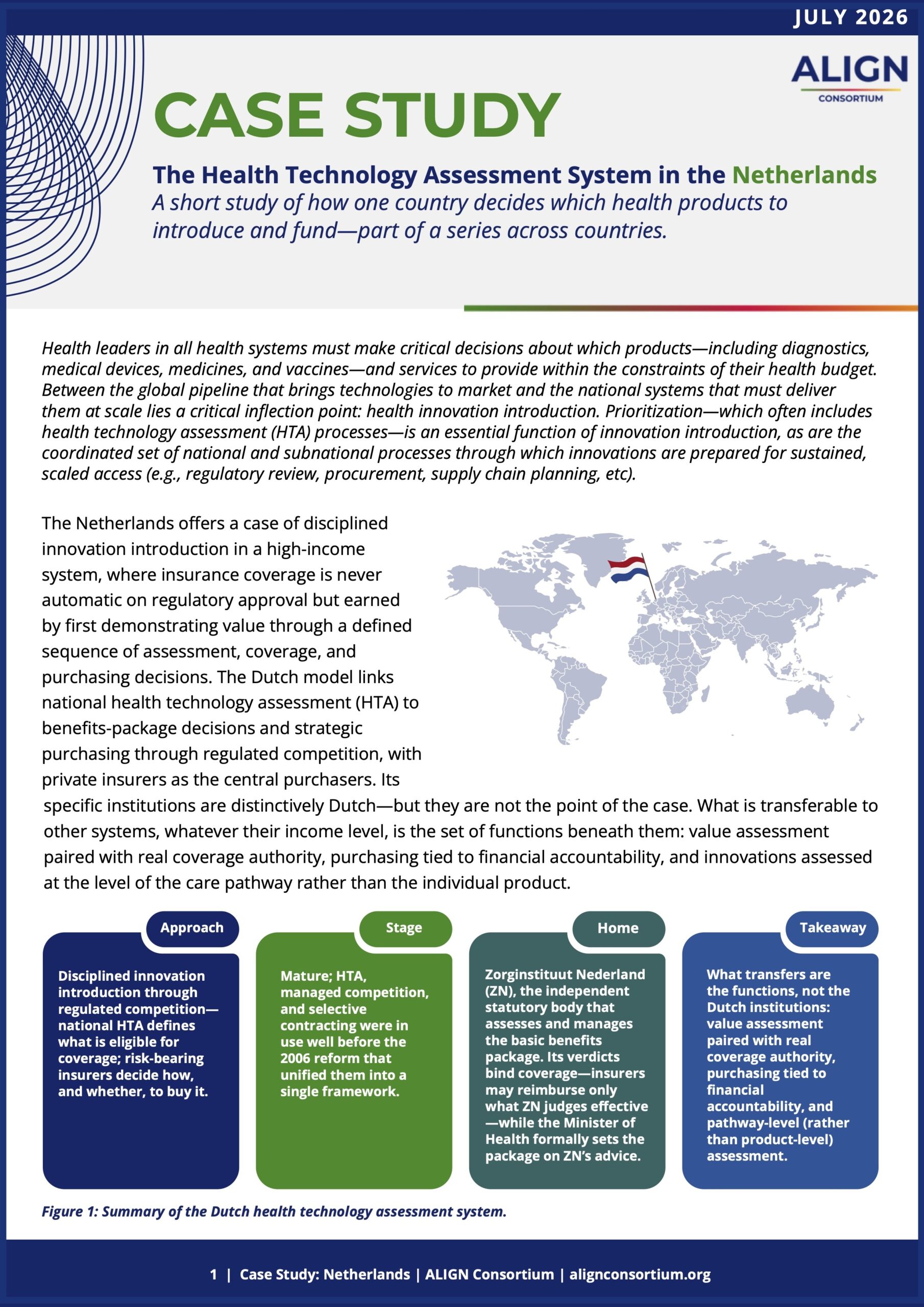
The Netherlands offers a case of disciplined innovation introduction in a high-income system, where insurance coverage is never automatic on regulatory approval but earned by first demonstrating value through a defined sequence of assessment, coverage, and purchasing decisions. The Dutch model links national health technology assessment (HTA) to benefits-package decisions and strategic purchasing through regulated competition, with private insurers as the central purchasers. Its specific institutions are distinctively Dutch—but they are not the point of the case. What is transferable to other systems, whatever their income level, is the set of functions beneath them: value assessment paired with real coverage authority, purchasing tied to financial accountability, and innovations assessed at the level of the care pathway rather than the individual product.
This case study is one in a series of decision-making deep dives produced by the ALIGN Consortium as part of our shared learning agenda. Each examines how a particular country has navigated the persistent challenge of introducing new health innovations—how it evaluates, prioritizes, finances, and sustains them within real fiscal and political constraints. Our aim is not to rank systems or prescribe a single model, but to understand how reform actually unfolds: what enables it, what constrains it, and what does and does not transfer across contexts. These cases inform ALIGN’s work alongside national partners and are offered in the spirit of mutual learning. We welcome reactions, corrections, and counter-examples from colleagues who know these systems first-hand.